EDITORIAL ARTICLE

ISSUES OF COMPLIANCE WITH CHEMICAL AND BIOLOGICAL WEAPONS CONVENTIONS
Highlights
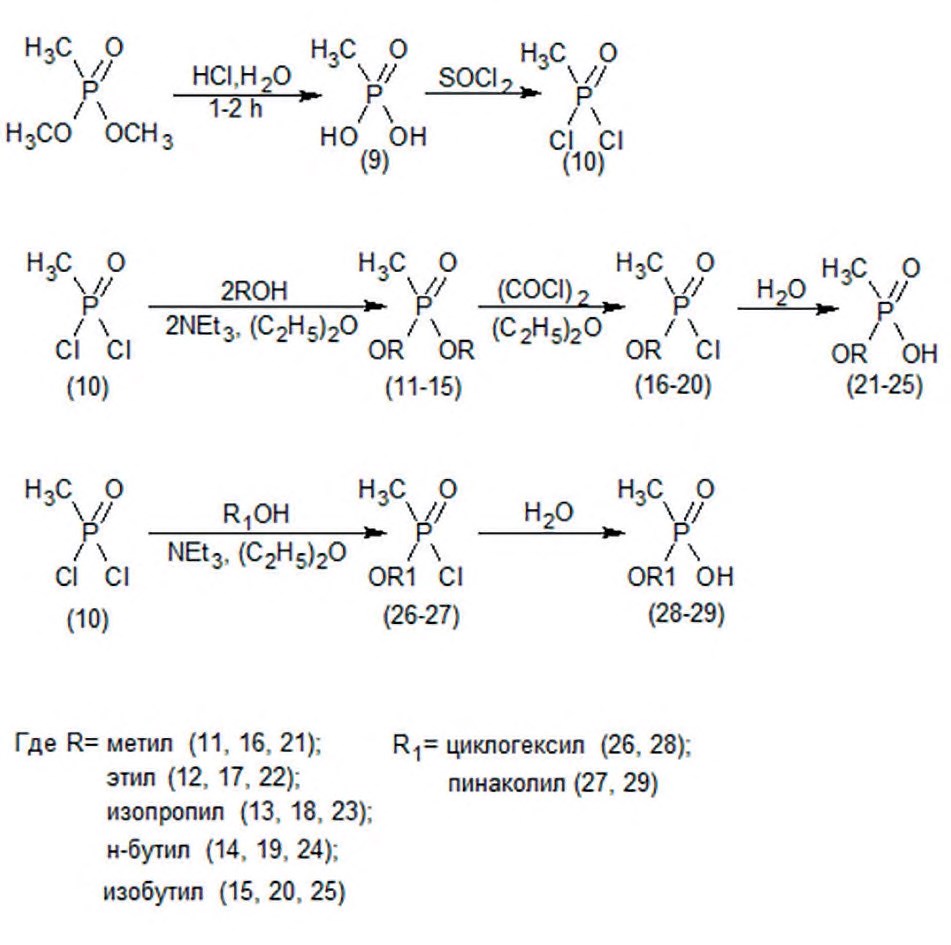
- Analysis of toxic chemicals and their derivatives, conducted under the Convention on the Prohibition of Chemical Weapons and various expert assessments in radiation, chemical and biological defence (RCB defence) units, has revealed the need for modifying reagents to unambiguously determine and identify introduced substances of various classes.
- Forty-two O-benzylalkyl methylphosphonic acids were synthesized, including 4-trifluoromethul-2,3,5,6tetrafluorobenzyl, pentafluorobenzyl, and 4-brombenzyl derivatives.
- In the study of the benzylation reaction kinetics, it was found that the 4-trifluoromethyl-2,3,5,6-tetrafluorobenzyl bromide exhibits the highest reactivity in benzylation reactions.
Relevance. The danger associated with the use of these toxic chemicals has increased under current conditions. This underscores the necessity of maintaining high operational speed and comprehensive accuracy in the implementation of chemical analytical control protocols.
Purpose of the study is to study of the features of obtaining substituted benzyl esters of O-alkylmethylphosphonic acids and the kinetics of reactions of benzyl bromides with certain esters of methylphosphonic acid.
Objectives of the study:
- Synthesis of benzyl esters of O-alkyl methylphosphonic acids.
- Evaluation of the alkylating activity of benzyl bromides in reactions with methyl, ethyl, isopropyl, butyl, isobutyl, cyclohexyl, pinacolyl esters of methylphosphonic acid.
- Identification of the most effective alkylating reagents for derivatization.
Materials and Methods. Preparative synthesis methods, NMR spectroscopy methods.
Results. Forty-two O-benzylalkyl methylphosphonic acids were synthesized. The most preferred alkylating agent for O-alkyl methylphosphonic acids, 4-trifluoromethyl-2,3,5,6-tetrafluorobenzyl bromide, was identified, as well as the ester exhibiting the highest reactivity with benzylating agents isobutyl methylphosphonic acid ester.
Conclusions. Polyfluorobenzyl esters of O-alkyl methylphosphonic acids were synthesized. The alkylating activity of benzyl bromides in reactions with methyl, ethyl, isopropyl, butyl, isobutyl, cyclohexyl, pinacolyl esters of methylphosphonic acid esters was studied. The most effective alkylating reagents for derivatization were identified. Practical significance of the work. The synthesized compounds can be proposed as reference samples for comparing methylphosphonic acid derivatives during chemical-analytical control; their synthesis will enable the creation of a database of NMR spectra and mass spectra for gas and liquid chromatography, ensuring high reliability and efficiency in analytical tasks.
WEAPONS AND MEANS OF NBC PROTECTION TROOP
Highlights
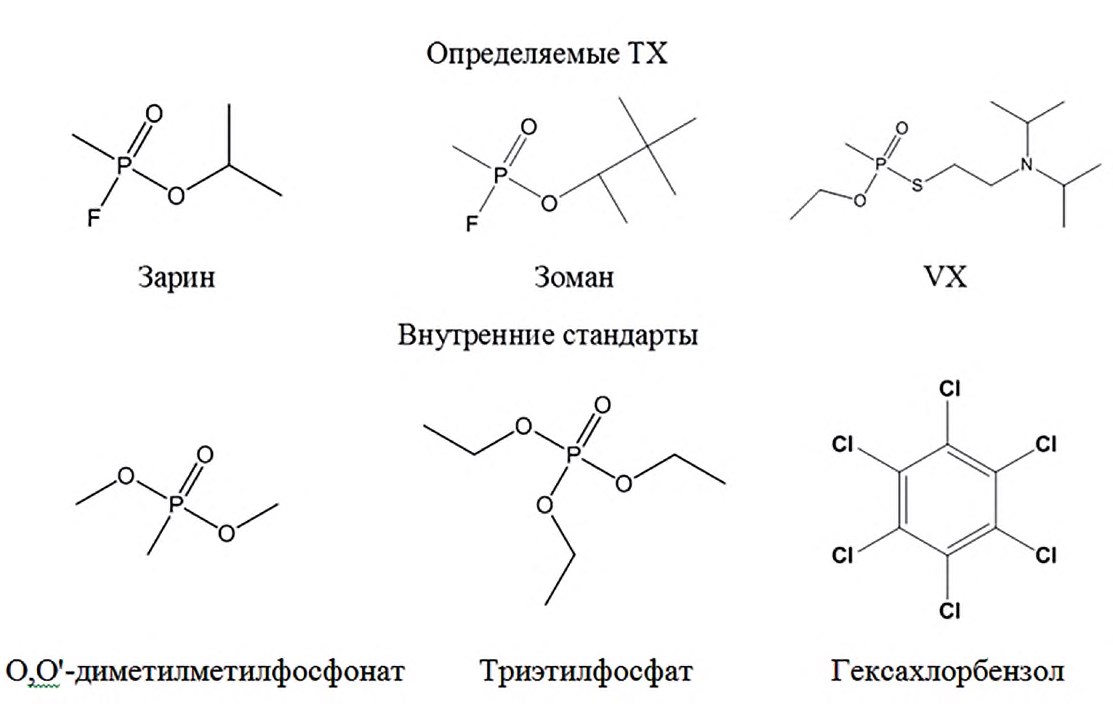
- The use of an internal standard (IS) is promising for the development of quantitative gas chromatographic (GC) methods for the determination of toxic chemicals (TCs).
- A quantitative criterion for assessing the suitability of an IS is proposed.
Relevance. Without data on TC concentration, it is impossible to assess the level of chemical contamination, plan post-contamination recovery measures, or evaluate the risks of adverse effects of hazardous chemical agents on the population and the environment.
Purpose of the study is to propose and validate a criterion for assessing the suitability of internal standards for the quantitative gas chromatographic determination of toxic chemicals.
Materials and methods. The study objects were α-chloroacetophenone (a model toxic chemical) and five potential internal standards (n-decane, m-nitrotoluene, diphenyl, trinitrotoluene, methyl stearate) that differ from the analyte in lower toxicity and higher availability. Solutions were prepared in dichloromethane in the concentration range 0.1–2000 μg/cm[3] . The analysis was performed by gas chromatography with flame ionization detection (GC FID) using an Agilent Technologies 6890N instrument equipped with an HP 5MS capillary column. Calibration curves were constructed for each substance, the slopes were calculated, and their proximity was evaluated. Statistical processing of the results (identification of outliers using the Smirnov–Grubb test) was performed to justify the quantitative criterion for the suitability of internal standards.
Results. Based on experimental data, calibration dependences of the target toxic chemical and the potential internal standards were obtained. Using statistical processing, a quantitative criterion for assessing the suitability of an IS for quantitative GC determination of TCs was validated, and the relative calibration coefficients of the TC with respect to the ISs were calculated. Using α chloroacetophenone as an example, the feasibility of applying the slope of the IS calibration curve and its proximity to the slope of the analyte calibration curve as a quantitative criterion for the suitability of a substance as an IS was demonstrated.
Conclusions. A quantitative criterion is proposed that allows assessment of the applicability of internal standards selected from readily available substances with significantly lower toxicity than the target toxic chemicals for quantitative GC determination of TCs.
Practical significance of the work. The proposed criterion makes it possible to mathematically confirm the correct choice of an IS and to simplify the development of quantitative GC methods with low errors. The obtained results can be used in laboratories dealing with physiologically active substances.
Highlights
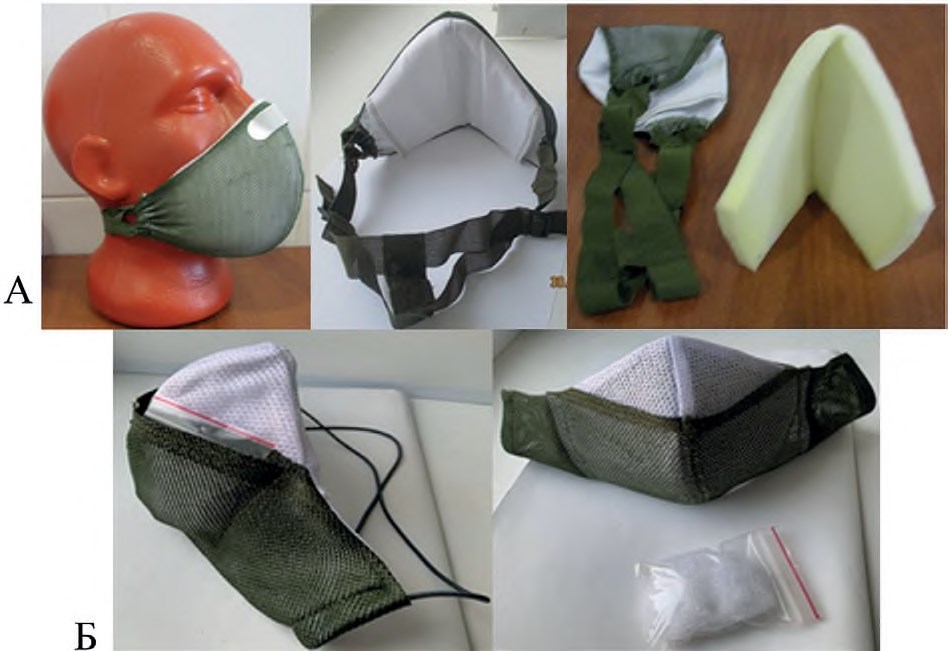
- An impregnation for filtering materials has been developed, increasing the protective action time (PAT) of a respirator against radioactive iodine by a factor of 15.9.
- The technology is based on readily available components (sodium thiosulfate, glycerin, chlorhexidine), which makes it significantly cheaper than existing analogues.
Relevance. During accidents at nuclear power plants (Chernobyl, Fukushima), the release of radioactive iodine-131 ([131] I) poses a critical health threat due to its rapid entry through the respiratory tract. Existing respiratory protective devices (RPD) have insufficient effectiveness against organic iodine compounds and are expensive, which limits their widespread use.
Purpose of the study is to develop and experimentally justify a set of measures for improving the effectiveness of respiratory protection against radioactive iodine and its volatile organic compounds (CH3I, C2H5I) generated during accidents at nuclear power plants.
Materials and Methods. Sorption elements made of polyurethane foam grades ST-1832 and ST-2238 were studied. Impregnations were prepared based on aqueous solutions of sodium thiosulfate (0–50%), glycerin and 0.05% chlorhexidine solution. The composition was applied using a trigger sprayer (consumption 0.15 mL/cm[2] ). Tests were carried out using a specially designed setup at a temperature of 20±1 °C, iodine vapour concentration of 4.16 g/m[3] , and air flow rate of 15±0.3 L/min. The protective action time was recorded when a blue colour appeared in the starch indicator. Each experiment was repeated at least six times. Statistical processing (outlier detection using the SmirnovGrubbs test, linear regression) was performed in MS Excel.
Results. The following were developed:
- a multicomponent impregnation (50% sodium thiosulfate, glycerin, 0.05% chlorhexidine solution in equal volumes), increasing the PAT of ST-1832 polyurethane foam from 7.6±0.4 to 77.8±3.9 min (by a factor of 10.2);
- an experimental setup for determining the PAT of filtering materials;
- a replaceable filter element made of polyurethane foam with a modular design;
- a technology for uniform impregnation application and modification of commercially available respirators (using the 3M respirator as an example).
For the ST-2238 sample impregnated with a 50% sodium thiosulfate solution and placed in a 3M respirator, the PAT reached 120.7±6.0 min, and the I2 capacity was 7531.7±376.6 mg, which is 15.9 times higher than that of the standard R-2 respirator. A linear dependence of PAT on sodium thiosulfate concentration was established (R2 = 0.98). Four patent applications and four utility model applications have been filed.
Conclusion. The developed technical solutions provide a 15.9 fold increase in protective action time, use readily available components, do not require sophisticated equipment, and are suitable for mass application when building strategic reserves and equipping personnel involved in the aftermath of radiation accidents.
Practical significance of the work . The obtained results allow a substantial improvement in the effectiveness and affordability of respiratory protective devices against radioactive iodine for equipping personnel involved in the aftermath of radiation accidents.
Highlights
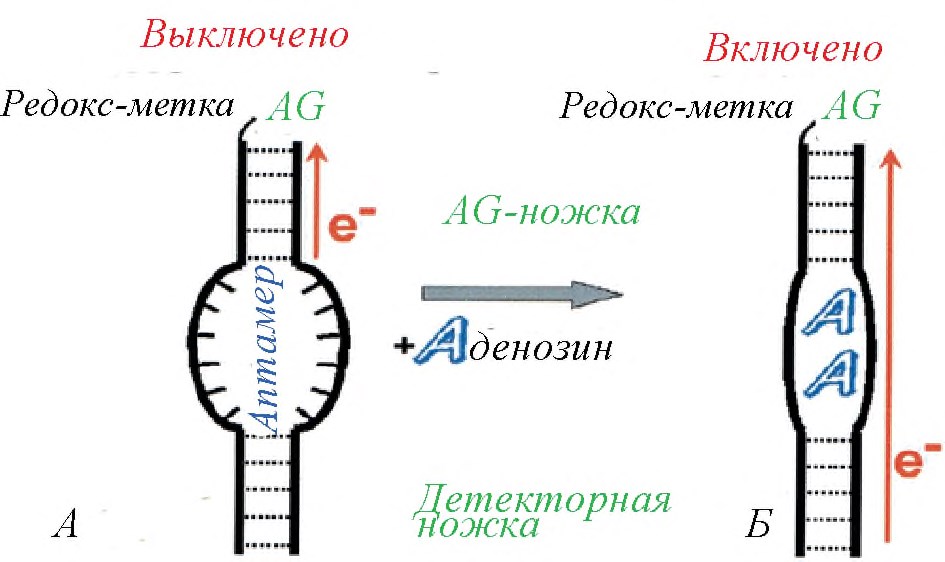
- A concept of a biological aerosol detector based on a DNA conductivity molecular switch is proposed, enabling species specific identification of bacterial and viral agents within ≤1 min without laboratory confirmation, with single molecule sensitivity for nucleic acids.
- A dry MEMS impactor with aerodynamic focusing (nozzle diameter 0.3 mm, flow rate 2–3 L/min) is designed, providing particle delivery to the sensor in <10 s and collection efficiency >80 % for particles in the 1–10 μm range. A three level tactical architecture for swarm biological reconnaissance using VTOL UAVs is substantiated (LIF trigger → AI analytics → DNA sensor), incorporating Edge AI for false positive filtering, secured radio links (LoRa, 5G NR U), and satellite navigation (GPS/GLONASS).
- Key technical solutions (including impactor design, UAV architecture, and sampling methods) are protected by at least 6 Russian patents, confirming the technological feasibility of the concept.
- The proposed approach enables a transition from non specific indication to direct electrochemical identification of pathogen nucleic acids, overcoming the major drawback of existing biological reconnaissance systems the inability to confirm the agent type without laboratory analysis.
Relevance. Existing military biological reconnaissance devices (ASP family) and laboratory methods (PCR, ELISA, UV laser induced fluorescence) do not provide species specific identification of biological warfare agents (BWA) in real time sufficient for donning personal protective equipment. The technological limit in the development of such means has already been reached.
Purpose of the study is to develop a concept of a biological aerosol detector for military biological reconnaissance systems based on a DNA conductivity molecular switch, with the ability to integrate into unmanned aerial vehicles, CBRN reconnaissance vehicles, and automated command and control systems.
Materials and methods. A systematic analysis of scientific, technical and patent information (2020–2026) was performed using the IEEE Xplore, Nature Communications, Physics Letters A, Biosensors & Bioelectronics databases, as well as patent documents from Russia, the USA and WIPO. Content analysis, structural functional synthesis and calculation based estimates of impactor parameters were applied.
Results. An electrochemical detection principle for biological aerosols based on a DNA conductivity molecular switch has been validated, providing single molecule sensitivity and a response time of ≤1 minute. A dry MEMS impactor with aerodynamic focusing is proposed, providing particle delivery to the sensor in <10 s and collection efficiency >80 % for particles 1 10 μm at a nozzle diameter of 0.3 mm. A tactical architecture for swarm based biological reconnaissance using VTOL UAVs has been developed, including a three level scheme (LIF trigger → AI analytics → DNA sensor), Edge AI, secure radio links (LoRa, 5G NR U) and satellite navigation (GPS/GLONASS). Key technical solutions are shown to be protected by Russian patents.
Conclusion. The proposed concept overcomes the main drawback of existing CBRN reconnaissance systems inability to identify the biological agent without laboratory confirmation ensuring a transition from non specific indication to direct electrochemical detection of nucleic acids with a total cycle time ≤1 minute.
Practical significance of the work. Lies in creating a scientific and technical groundwork for initiating research and development (R&D) on field deployable detectors integrated into unmanned aerial systems, CBRN reconnaissance vehicles, and stationary posts.
Highlights
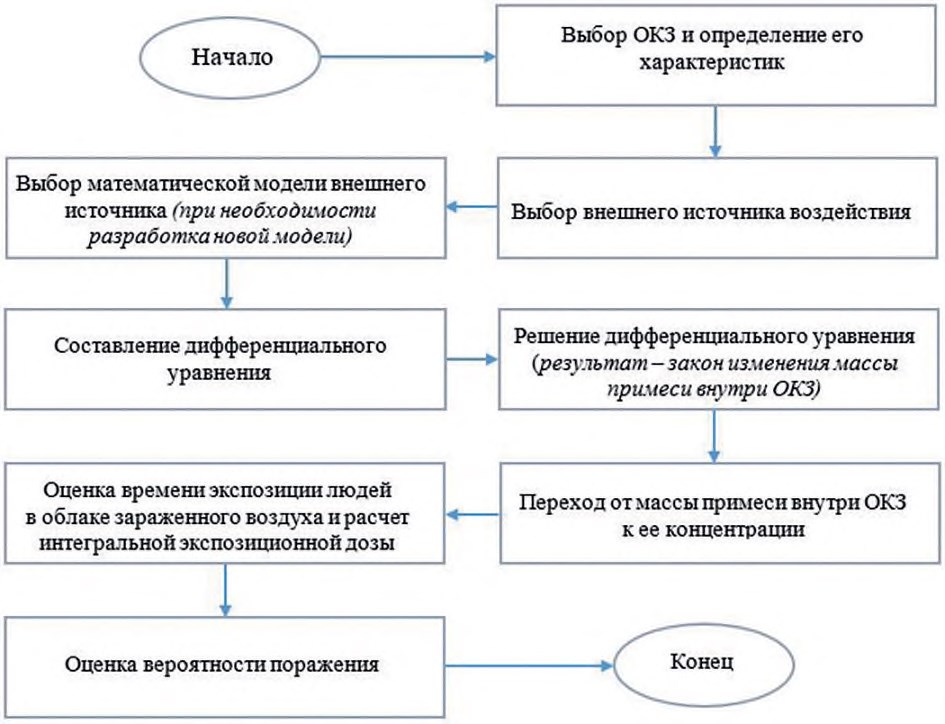
- Analytical relationships (formulas (11) and (16)) have been derived that link the parameters of the external aerosol cloud from an instantaneous point source with the change in chemical agent concentration inside a collective protection facility.
- For the first time, explicit expressions are obtained for the integrated exposure dose CT accumulated by personnel during their stay in the shelter, taking into account the filter-ventilation unit performance and the penetration factor.
Relevance. The existing averaging method does not account for the dynamics of contaminated air inflow and yields an underestimated risk of injury.
Purpose of the study is to derive analytical relationships for calculating the aerosol mass transfer from the external atmosphere into the internal volume of a collective protection facility (CPF) for an instantaneous point source.
Study base sources. Open publications on pollutant dispersion, the theory of chemical weapon effects, and design of filter-ventilation systems.
Method. Analytical solution of a differential mass balance equation with a time variable external concentration (Gaussian model).
Discussion. The traditional approach is limited to time averaging of concentration, ignoring the actual time course of Cвн (t) inside the shelter. In contrast, the proposed methodology:
- provides explicit expressions for C вн (t) (formula (11)) and CT (formula (16)) that involve error functions erf and exponentials;
- takes into account all key parameters: shelter volume V , filter ventilation unit capacity Q , penetration factor K пр, source strength Q Т, wind speed u , dispersion parameter σ x;
- allows estimation of not only the average but also the peak load on personnel, which is critically important for short term aerosol releases.
Practical validation with numerical calculations is planned in subsequent work.
Conclusion. The obtained relationships provide a theoretical foundation for developing a more accurate (compared to the averaging approach) method for assessing the chemical protection effectiveness of CPFs.
Practical significance of the work. The methodology is applicable to an instantaneous point source and can be extended to other source types (line, area), thus broadening its use in the analysis of consequences of chemical strikes.
Review

ISSN 3034-2791 (Online)